
Nowadays, our politics is habituated to sitting on a high pedestal, hobnobbing with world leaders, generating impressions of a superpower and returning to earth for the purpose of winning elections. In contrast, the yatra never left earth, observes Shyam G Menon.
NPA issues in the banking sector, standoffs in Parliament denting the reform momentum and limited space on the fiscal side are among the major concerns for investors.

That's why he is now finally focusing on the two things that alone can help: Fiscal expansion -- from December onwards -- and supply management via amended laws and rules that affect business, notes T C A Srinivasa-Raghavan

'Recent underperformance notwithstanding, equities should constitute a major part of investors' financial portfolio.'

The UK voted to leave the European Union after 43 years.
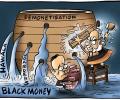
Assuming that demonetisation had not happened, the value of notes in circulation this year could have increased to Rs 19.3 lakh crore. But what we have, instead, by the end of August is a 20 per cent lower figure for currency notes in circulation, says A K Bhattacharya.

'That is the one headline the world is reading about India this week, and it is a potentially damaging story...' 'I don't think a panic mentality has set in, but this story is one that investors and market watchers are absolutely seized with.'

"Demand for gold is virtually zero," said Suresh Hundia, president of the Bombay Bullion Association. "People are taking profits and selling their gold back to jewellers for 2.5-3 per cent less than international market prices."

When he didn't respond (Mr Saver has lost count of how many relationship managers he has had in the past few years!), the gentleman landed up at his doorstep and started pleading with him to open fixed deposits with the bank, observes Tamal Bandyopadhyay.

Coming Wednesday, Finance Minister (FM) Nirmala Sitharaman will present the 2023 Union Budget - the last full Budget ahead of the 2024 Lok Sabha elections. While India exited 2022 as a relatively bright spot in the global economy, the FM will endeavour to present a Budget that insulates India's economy against global headwinds and recession in advanced economies, while sticking to the path of fiscal consolidation. In this, she is being helped by her core team of trusted advisors.

The Sri Lankan government has appointed an advisory committee comprising eminent economic and fiscal experts to provide guidance on addressing the current debt crisis and engaging with the International Monetary Fund (IMF) and other lenders as the country struggles to combat the unprecedented shortage of foreign reserves.
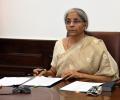
Rationalisation of income tax slabs, infrastructure status for digital services and incentives to hydrogen storage as well as fuel cell development were some of the suggestions made by various stakeholders at the pre-Budget consultation meeting convened by Finance Minister Nirmala Sitharaman. The customary pre-Budget consultation meetings were held with the finance minister virtually between December 15 and December 22, as per the finance ministry statement. More than 120 invitees representing seven stakeholder groups participated in eight meetings, scheduled during this period, it said.

Vanita Kohli-Khandekar on why Indian media and entertainment quality will remain a national gripe and why we, the viewers, are not blame free.
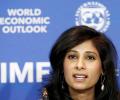
The IMF on Tuesday cut India's economic growth forecast by 0.5 percentage points to 9 per cent for the current fiscal year, with its chief economist Gita Gopinath saying that the slight downgrade is mainly due to the impact of the spread of the Omicron variant. "If you look at the 2021-22 fiscal year, we have a slight downgrade of -0.5 percentage points and for the next fiscal year 2022-23 we have a slight upgrade of 0.5 percentage points. So, growth for the previous fiscal year is now nine per cent and for this year now is at nine per cent. We moved it up slightly," Gopinath told reporters during a news conference in Washington. In its latest update of World Economic Outlook on Tuesday, the International Monetary Fund has cut India's economic growth forecast to 9 per cent for the current fiscal year ending March 31, joining a host of agencies which have downgraded their projections on concerns over the impact of the spread of Omicron on business activity and mobility.
.jpg)
Eminent free market economist Arvind Panagariya has been appointed to run Indian Prime Minister Narendra Modi's new Policy Commission, set up to modernise economic strategy after decades of Soviet-style central planning.
Let's take a look at some cities, including one from India, where owning a car in an expensive expenditure.

It will bear fruit in the next five years, which is why FDI is so strong. The foreigners clearly know what Indians don't, asserts T C A Srinivasa-Raghavan.

Economist Gandhi: The Roots and the Relevance of the Political Economy of the Mahatma by retired entrepreneur Jerry Rao provides insights into a hidden facet of Gandhi's personality -- his thoughts on economics and capitalism -- and also highlights some of his views on religion, ethics, human nature, education and society.

While selling started in April, it has intensified this month, with FPIs pulling out $1.1 billion and $2.5 billion from equities and debt market, respectively
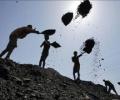
The CIL disinvestment has been hanging fire because of opposition from the trade unions. Mayaram's statement that the coal major will have to pay a higher dividend comes as the government makes efforts to meet its Rs 40,000 crore (Rs 400 billion) disinvestment target.

S&P Global Ratings on Wednesday slashed India's GDP growth forecast for the current financial year to 9.8 per cent saying the second Covid wave may derail the budding recovery in the economy and credit conditions.

'Yet the market didn't do all that badly because it was cushioned by domestic inflows.'

Experts say Indian students will have to accept that international space for them is shrinking.

'Mr Modi would compliment a Nobel Prize winner, but members of his party or the government would not be restrained from either making unfair comments or criticising him for having offered advice to an Opposition political party,' says A K Bhattacharya.

If the central banks act harshly now, the markets will crash and then rally. If they are hesitant, the pain will be prolonged, predicts Debashis Basu.

Singapore retained its title as the world's most expensive city for the fourth consecutive year, while Hong Kong remained second, closely followed by Zurich at the 3rd place.

The Centre should privatise all public sector banks (PSBs), except the State Bank of India (SBI). This is because private banks have emerged as a credible alternative to PSBs with substantial market share. Also, government ownership hinders the ability of the Reserve Bank of India (RBI) to regulate the sector, according to a report by the National Council of Applied Economic Research (NCAER).

The seasonally adjusted IHS Markit India Manufacturing Purchasing Managers' Index (PMI) was at 54.9 in February, up from 54.0 in January, signalling a stronger improvement in the sector's health. The February PMI data pointed to an improvement in overall operating conditions for the eighth straight month. In PMI parlance, a print above 50 means expansion, while a score below 50 denotes contraction.

The Asian Development Bank (ADB) on Wednesday slashed India's GDP growth forecast for FY23 to 7 per cent from the earlier estimate of 7.2 per cent mainly on account of higher inflation and a tight monetary policy. India's economy grew 13.5 per cent year-on-year in the first quarter of 2022-23, reflecting strong growth in services, ADB said in its second supplement to Asian Development Outlook Report 2022 (ADO 2022). "However, GDP growth is revised down from ADO 2022's forecasts to 7 per cent for FY2022 (ending March 2023) and 7.2 per cent for FY2023 (ending March 2024) as price pressures are expected to adversely impact domestic consumption, and sluggish global demand and elevated oil prices will likely be a drag on net exports," ADB said.

To propel demand, one should concentrate on indirect taxes and bring down the goods and services tax (GST) rates to a uniform 12 per cent as the Vijay Kelkar panel had recommended, said Ajit Ranade, chief economist at Aditya Birla Group.

Good intentions are best left to political parties, governments and religious establishments, suggests T C A Srinivasa-Raghavan.
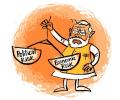
'Should the most important part of economic reform not comprise the way we look at the fiscal deficit?', asks T C A Srinivasa Raghavan.

The current slowdown has lasted for over 18 months and is the longest incident of sluggishness since 2006.

Economists praise Das for his pragmatism and willingness to face challenges head on. And in doing so with the finesse of an able administrator.

Ajit Balakrishnan on how to arrest a worldwide decline.
For those who think India's democracy is just fine and there has been no change in the last few years, perhaps it would be instructive to see what has happened on a few issues, observes Aakar Patel.
Confederation of Indian Industries said on Monday that the economy has shown clear signs of a turnaround over the last four quarters with sales

Delhi government had introduced the scheme in 2016 seeking to check dropout of the students and improve education quality with special focus on the weakest students.

India's economy will do well once vaccination reaches a critical mass as pent up demand, global recovery and easy financial conditions will boost activities, RBI's Monetary Policy Committee (MPC) member Ashima Goyal said on Tuesday.
